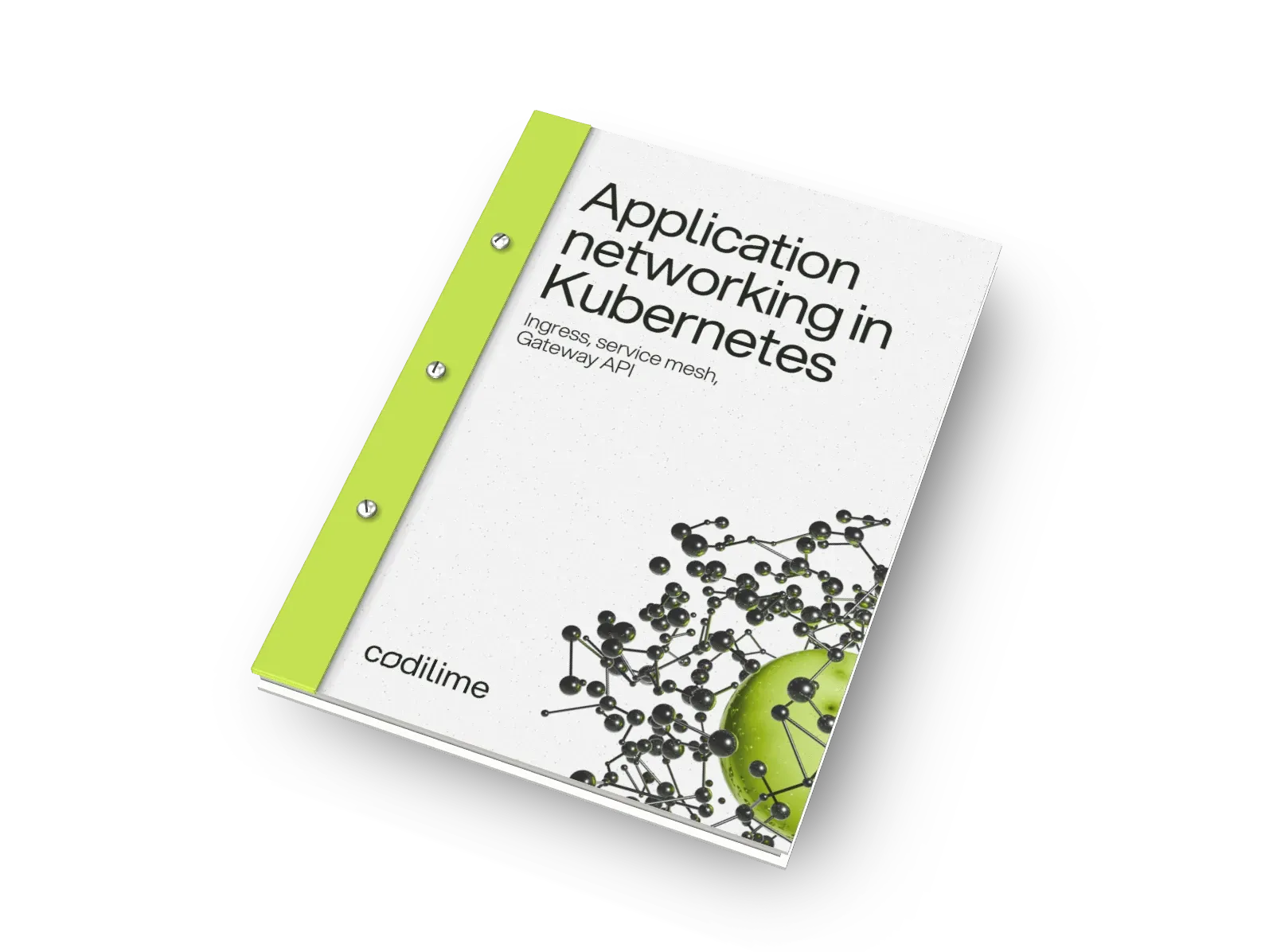
Application networking in Kubernetes
Traffic entering a Kubernetes cluster and moving between its workloads can run on three L7 options: Ingress, a service mesh or Gateway API.
This guide recaps the cluster network model, then compares the three with YAML for each: an observability application configured with Ingress and with Gateway API, and a scenario adding header-based matching, a redirect and a canary split.
The main topics covered in this e-book:
- The Kubernetes network model: CNI plugins, Services, kube-proxy and CoreDNS
- Ingress for north-south traffic, with a path-based routing example
- Service mesh for east-west traffic, including an SMI TrafficSplit canary
- Gateway API roles, xRoutes and its three support levels
- Ingress and Gateway API YAML side by side, basic and advanced scenarios
Why download this e-book?
How do Pods connect and talk in Kubernetes?
The ebook explains the Kubernetes network model: CNI plugins such as Calico, Cilium and Flannel, Services and kube-proxy, and the internal DNS, CoreDNS.
When is Ingress the right fit?
Ingress handles north-south traffic entering the cluster with L7 routing. A path-based routing example shows several applications sharing one domain name through a common entry point.
What does a service mesh add?
A service mesh gives fine-grained control of east-west traffic between workloads. The ebook shows a traffic split configured with the SMI specification and how to tell which cases suit Ingress and which suit a service mesh.
Why look at Gateway API?
Gateway API offers a wider set of advanced functions in a standard way and can be considered the successor to Ingress. The ebook covers its roles and support levels and rebuilds an Ingress configuration with it.
Related content
- ArticleAutomationONUG Fall 2026 takeaways: Networks must change faster, and few teams have a safe place to test
 Krzysztof Wróbel11 min read

- ArticleSecurityWhen buy is only the beginning: making firewall management move at DevOps speed
 Benjamin Wharton7 min read

- ArticleAutomationWhen build is the right answer: how eBay automated its data center fabrics with Spectron
 Benjamin Wharton7 min read
- ArticleAutomationThe complete guide to build vs. buy in network automation
 Benjamin Wharton14 min read
Ready to modernize?
Tell us where your data center is today, and we’ll take it from there — all the way to AI-ready.