← Back to Capabilities

Capability

Orchestration & Management

Orchestration is the control layer of the modern data center. It turns a pile of individually well-managed devices and cloud services into one coherent, policy-driven logic. It decides what the network as a whole should do, then coordinates every domain manager underneath to make that true. This matters because multi-vendor, multi-cloud estates have made manual, device-by-device change unsustainable. CodiLime has been doing hands-on, multivendor network engineering since 2011, and the same discipline now carries through to GenAI and agentic orchestration.

Measured impact

What we deliver

  • Multi-vendor network orchestration and management

    FCAPS-aligned monitoring, configuration, and operations tooling across multi-vendor network devices and white-box estates.

    Read the case study →
  • Cloud and hybrid integration and orchestration

    Terraform and Ansible modules, including custom-built providers, that turn error-prone multi-cloud onboarding into repeatable Infrastructure-as-Code.

    Read the case study →
  • Legacy-to-automated migration

    Transition from legacy infrastructure setup and tooling to a modern, cloud-native and IaC deployment model with automation and observability.

    Read the case study →
  • Abstraction layer design

    Adapter-pattern abstraction layers that let a single orchestrator reach both CLI-only legacy gear and modern model-driven APIs through one consistent interface.

    Read the case study →
  • Service orchestration and lifecycle automation

    End-to-end orchestration of network services across multiple vendors and domains, exposed through northbound APIs, so the business asks for the service.

    Read the case study →
  • Network observability and closed-loop automation

    Telemetry aggregation and anomaly detection wired directly into orchestration, correcting drift automatically.

    Read the case study →
  • GenAI-assisted and agentic network operations

    LangChain/LangGraph-based copilots and agents that interpret operator intent, propose the right playbook, and execute it under strict policy and human approval.

    Read the case study →

How we do it

We build orchestration platforms layer by layer, so the foundation is reliable before any AI logic goes on top.

  1. Telemetry and source of truth

    Data ingestion, streaming telemetry, config state, and a robust source of truth such as NetBox or Nautobot. We know the domain before we automate it.

  2. Statistics and classic ML

    Data engineering and classic machine learning, from classification, clustering and anomaly detection to time-series forecasting for predictive maintenance.

  3. Task automation

    Abstractions and renderers to operate on heterogeneous infrastructure, using Ansible, Terraform, and Nornir to automate unitary operations.

  4. Composing tasks into orchestrated business services

    Workflow engines such as Temporal and Prefect, or custom ones, that turn individual tasks into governed services.

  5. AI-based decision support and human-approved automation

    GenAI turns operator queries into safe, executable automation logic. Policy-based, intent-driven agents run end to end, gated by human approval after the impact is explained.

Technology

  • Source of Truth & Inventory

    • Nautobot
    • NetBox
  • Automation & Config Mgmt

    • Ansible
    • Terraform
    • Puppet
    • SaltStack
    • Nornir
    • NAPALM
    • Netmiko
  • Orchestration & Workflow

    • Temporal
    • Prefect
    • Kubernetes
    • Cloudify
  • CI/CD & GitOps

    • GitHub Actions
    • GitLab CI
    • ArgoCD
    • Jenkins
    • Spinnaker
    • Backstage
  • GenAI & Advanced AI

    • LangChain
    • LangGraph
    • PyTorch
    • LLM copilots
  • Core Programming Languages & Frameworks
    • Python
    • Go
    • C++
    • React
    • FastAPI

Proof of capability

Why CodiLime

  • Network engineers first, software engineers too

    Orchestration logic is developed by people who have configured the underlying devices themselves. We have been doing protocol-level network engineering since 2011, and we combine it with modern software practice: Python, Go, Kubernetes, public clouds and CI/CD.

  • Vendor-agnostic by design

    We have delivered across telco, data center and enterprise networks, each running a different mix of vendors. The orchestration layer we build stays free of one vendor’s assumptions, and uses vendor-specific capabilities where they improve performance.

  • We layer, step by step

    We sequence telemetry, automation, orchestration, GenAI and agentic execution. Each layer is vetted before the next one goes on top of production infrastructure.

  • Orchestration at scale, in production

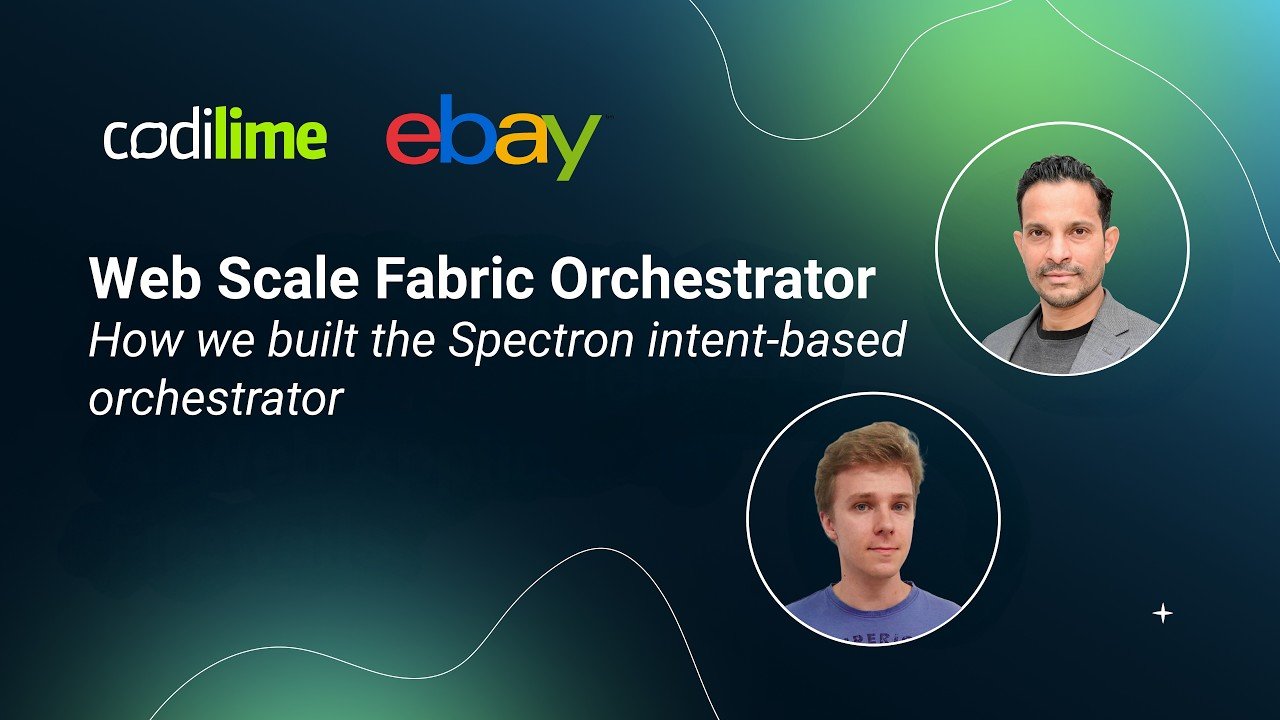
    CodiLime and eBay built Spectron, a platform for network orchestration at scale in a live production environment. It covers the fabric lifecycle from planning and specification through rack installation to zero-touch provisioning.

  • Trusted for the long haul

    CodiLime is ISO 27001 certified, and over half of our clients have been with us for more than five years. Named engagements include Cloudify, Nutanix and Palo Alto Networks.

FAQ

Good to know

  • We already automate with Ansible or Terraform. Why add orchestration?

    Task automation removes keystrokes. It does not own the outcome. If a change in one domain still needs a human to sequence three others, if rollback means “run the playbook backwards and hope”, or if nobody can state the desired network state, only the commands that were pushed, you have automation, not orchestration. Orchestration turns isolated jobs into a governed, intent-driven service change: dependencies, order, validation, and rollback are the product.

  • What is a good first use case — and what is a trap?

    Start with one repeatable, multi-domain, measurable lifecycle: fabric leaf add, L3VPN turn-up, circuit provisioning, controlled OS upgrade across a defined cohort. Trap: “orchestrate the whole estate” or “build a 40-vendor platform before the first service ships.” We start narrow, put one workflow into production, then expand the model. A platform with no production service is a PoC in disguise.

  • Our estate is multi-vendor and part of it is old CLI-only. Does that block us?

    No. It changes the cost, not the feasibility. A vendor-neutral model issues one structured request translated through adapters to multi-vendor network devices or white-boxes, using Southbound management interfaces (for example NETCONF, gNMI or a 15-year-old CLI). Legacy does not block the first service. It caps how dense automation can get and how fast you reach value. The real cost sits in parsers, idempotency, and tests. Adapters need an owner and a test contract on vendor upgrades.

  • Do we have to rip out NMS, OSS, BSS, or the tools we already paid for?

    No. We wrap and integrate. Your source of truth, ticketing, and existing automation stay in place. The orchestrator should read the systems you already trust, not pretend to replace them in quarter one. Rip-and-replace is a symptom of a failed integration, not a delivery strategy.

  • What happens when the orchestrator is wrong?

    Then it must fail. Dry-run and diff against source of truth, limited blast radius, compensated rollback, and a human gate on change classes that can hurt production. Orchestration without a state model and a rollback path is just more expensive Automation. NetOps does not lose control. It stops clicking routine changes and starts approving intent and exceptions.

  • What do you need from us, and how do we know this worked?

    A source of truth (even an ugly one) is highly appreciated, a domain owner, representative device access or a lab that matches production well enough, and one service with a clear definition of done. It is difficult to start a “platform” without an intent owner.

  • How do we deliver?

    We ship a concrete, measurable result in the first iteration. Up front we agree with you which outcome counts (for example one production workflow live, turn-up time against a baseline, a clear set of manual steps gone). You measure it, you verify it, you decide the next move. Who runs it later is explicit from the start: we transfer the model and step back, or we stay with it as it evolves.

  • Where does GenAI belong?

    AI may interpret intent, explain a plan, draft a playbook, or assist Root Cause Analysis. It does not write to production without human approval and it is not the source of truth. Execution uses the same governed path as a change with no AI. If we cannot audit it, we do not ship it.

Which change do you never want to make by hand again?

Tell us what it takes today and how many systems it touches. We’ll tell you what the orchestration layer would have to cover.